58 mm vs. 80 mm Thermal Printers
When businesses choose a thermal printer, most buyers focus on only two things: price and print quality. But in real commercial environments, the wrong printer size can create long-term operational problems that cost far more than the initial hardware investment.
The debate between 58mm and 80mm thermal printers is not simply about paper width. It affects transaction speed, maintenance frequency, customer experience, paper replacement cycles, and even queue management during busy hours.
For small businesses, retail stores, kiosks, restaurants, healthcare systems, parking machines, and self-service terminals, choosing the correct thermal printer width can improve daily efficiency significantly.
In this guide, we’ll break down the 7 business factors most buyers ignore before purchasing a 58mm or 80mm thermal printer.
Quick Comparison: 58mm vs 80mm Thermal Printers
| Feature | 58mm Thermal Printer | 80mm Thermal Printer |
| Paper Width | Smaller | Wider |
| Common Use | Portable POS, compact kiosks | Retail POS, self-service kiosks |
| Receipt Visibility | Limited space | Better readability |
| Paper Roll Capacity | Smaller rolls | Larger rolls |
| Maintenance Frequency | More frequent paper replacement | Less frequent |
| Print Speed | Moderate | Faster in commercial models |
| Best For | Small businesses | High-volume operations |
What Is a 58mm Thermal Printer?
A 58mm thermal printer is a compact receipt printer designed for lightweight printing tasks. These printers are commonly used in:
- Mobile POS systems
- Small retail counters
- Food delivery businesses
- Portable billing systems
- Compact self-service terminals
Their biggest advantage is space efficiency. Businesses with limited counter space often prefer 58mm printers because they are lightweight and easier to integrate into small hardware environments.
However, smaller paper width also means less printable area, which can become problematic for detailed receipts, QR codes, or multilingual content.
What Is an 80mm Thermal Printer?
An 80mm thermal printer is the industry standard for high-volume commercial printing environments. These printers are widely used in:
- Supermarkets
- Self-checkout kiosks
- Ticketing machines
- Parking systems
- Restaurant POS systems
- Healthcare registration kiosks
Because of the wider print area, 80mm printers produce more readable receipts and support larger logos, barcodes, QR codes, and detailed transaction data.
Most modern kiosk systems and Android POS terminals are optimized for 80mm printing because it improves customer readability and reduces formatting limitations.
1. Receipt Readability Matters More Than Most Businesses Expect
Many companies underestimate how important receipt readability becomes during busy operations.
A narrow 58 mm receipt may save paper, but it can also create the following:
- crowded text
- shortened product names
- compressed QR codes
- difficult-to-read invoices
This becomes especially problematic in industries like:
- retail
- healthcare
- ticketing
- banking
- parking systems
An 80mm thermal printer offers more printing space, allowing businesses to create cleaner and easier-to-read receipts with better formatting for product details, QR codes, barcodes, logos, and payment information.
In high-traffic environments, clearer receipts can reduce customer confusion and improve transaction flow.
2. Paper Roll Capacity Directly Impacts Operational Efficiency
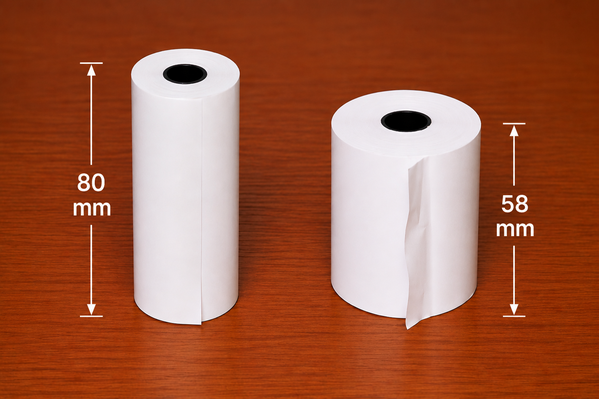
One of the biggest hidden differences between 58mm and 80mm printers is paper roll capacity.
Smaller 58mm thermal printers typically require more frequent paper replacement because the rolls hold less thermal paper.
That may sound minor, but in busy environments, frequent paper replacement can:
- interrupt customer service
- slow down checkout speed
- increase maintenance workload
- create downtime during peak hours
An 80mm printer with larger paper rolls can significantly reduce interruptions during daily operations.
For businesses processing hundreds of transactions per day, this difference becomes noticeable very quickly.
3. High-Volume Businesses Usually Benefit More from 80mm Printers
Businesses handling large transaction volumes often choose 80mm printers for one reason: stability under continuous use.
Commercial-grade 80mm thermal printers are commonly designed for:
- faster print speeds
- longer printhead lifespan
- better heat management
- industrial usage cycles
Many modern 80mm printers can print at speeds exceeding 200mm/s, helping reduce customer wait times in busy retail environments.
For self-service kiosks and automated systems, consistent printing speed becomes critical.
A delayed receipt in a kiosk environment can create user frustration almost instantly.
4. Integration Flexibility Is Often Better with 80mm Models
Modern businesses increasingly rely on integrated systems:
- Android POS
- self-service kiosks
- payment terminals
- vending machines
- ticketing systems
Many advanced 80mm thermal printers support:
- USB
- Ethernet
- Bluetooth
- WiFi
- Serial interfaces
- ESC/POS commands
This flexibility makes integration easier for developers and hardware manufacturers.
Although 58mm printers also support multiple interfaces, enterprise-grade integration options are generally more common in 80mm commercial models.
For businesses building automated environments, this becomes a major long-term advantage.
5. Long-Term Maintenance Costs Are Frequently Ignored
Many buyers focus only on the initial hardware price.
But over several years, maintenance costs can become far more important.
Cheap or undersized thermal printers often experience the following:
- cutter failures
- overheating
- paper jams
- worn printheads
- connection instability
Because 58mm printers are commonly used in compact environments, they may experience more heat concentration during continuous usage.
Commercial 80mm printers are often engineered with better cooling and durability for long operating hours.
For businesses operating 24/7 kiosk systems, reliability should always outweigh short-term savings.
6. Customer Experience Is Better with Larger Receipt Layouts
Modern receipts now include more than transaction totals.
Businesses increasingly print:
- QR codes
- loyalty programs
- return policies
- promotional offers
- tax details
- digital payment information
Trying to fit all of this onto a 58mm receipt can create cluttered layouts.
An 80mm receipt offers:
- cleaner formatting
- better barcode scanning
- improved logo visibility
- easier readability
This creates a more professional customer experience overall.
7. Future Scalability Is a Major Decision Factor
One of the most overlooked mistakes businesses make is choosing hardware only for current needs instead of future growth.
A small shop processing 50 daily transactions today may process 500 transactions within a few years.
Upgrading printer infrastructure later can:
- increase integration costs
- require software modifications
- disrupt operations
- create compatibility issues
Many businesses choose 80mm thermal printers early because they offer better scalability for future expansion.
For growing businesses, this can be the smarter long-term investment.
Which Industries Prefer 58mm Thermal Printers?
58mm printers are commonly used in:
- mobile payment systems
- handheld POS devices
- small cafes
- portable billing systems
- compact kiosks
- delivery operations
Their small footprint makes them ideal for environments with limited installation space.
Which Industries Prefer 80mm Thermal Printers?
80mm printers dominate industries such as:
- supermarkets
- transportation
- healthcare kiosks
- self-checkout systems
- ticketing machines
- parking systems
- vending kiosks
- large retail chains
These environments benefit from faster printing, larger paper rolls, and better receipt formatting.
58 mm vs. 80 mm Thermal Printers: Final Verdict
There is no universal “best” printer size.
The right choice depends on:
- transaction volume
- installation space
- receipt complexity
- integration requirements
- future scalability
- operational workload
A 58mm thermal printer is often ideal for compact and lightweight applications where space-saving matters most.
An 80mm thermal printer is usually the better investment for businesses requiring higher efficiency, better readability, and long-term scalability.
For commercial environments such as kiosks, Android POS systems, retail automation, and self-service terminals, many businesses ultimately prefer 80mm printers because of their operational advantages.
Is an 80mm thermal printer faster than a 58mm printer?
In many commercial models, yes. Most enterprise-grade 80mm printers are designed for higher print speeds and continuous operation.
Which printer size is better for kiosks?
80mm thermal printers are generally preferred for self-service kiosks because they support larger receipts, QR codes, and better readability.
Are 58mm thermal printers cheaper?
Yes, they are usually more affordable initially. However, long-term operational limitations may offset the lower purchase cost.
Which printer is better for retail stores?
For medium to high-volume retail operations, 80mm thermal printers are typically the better option because they provide faster printing and improved receipt presentation.
Can both printer sizes support Android POS systems?
Yes. Both 58mm and 80mm thermal printers can integrate with Android POS systems depending on interface compatibility and software support.